CL Full Form: Meaning, Rules, Reasons & Examples
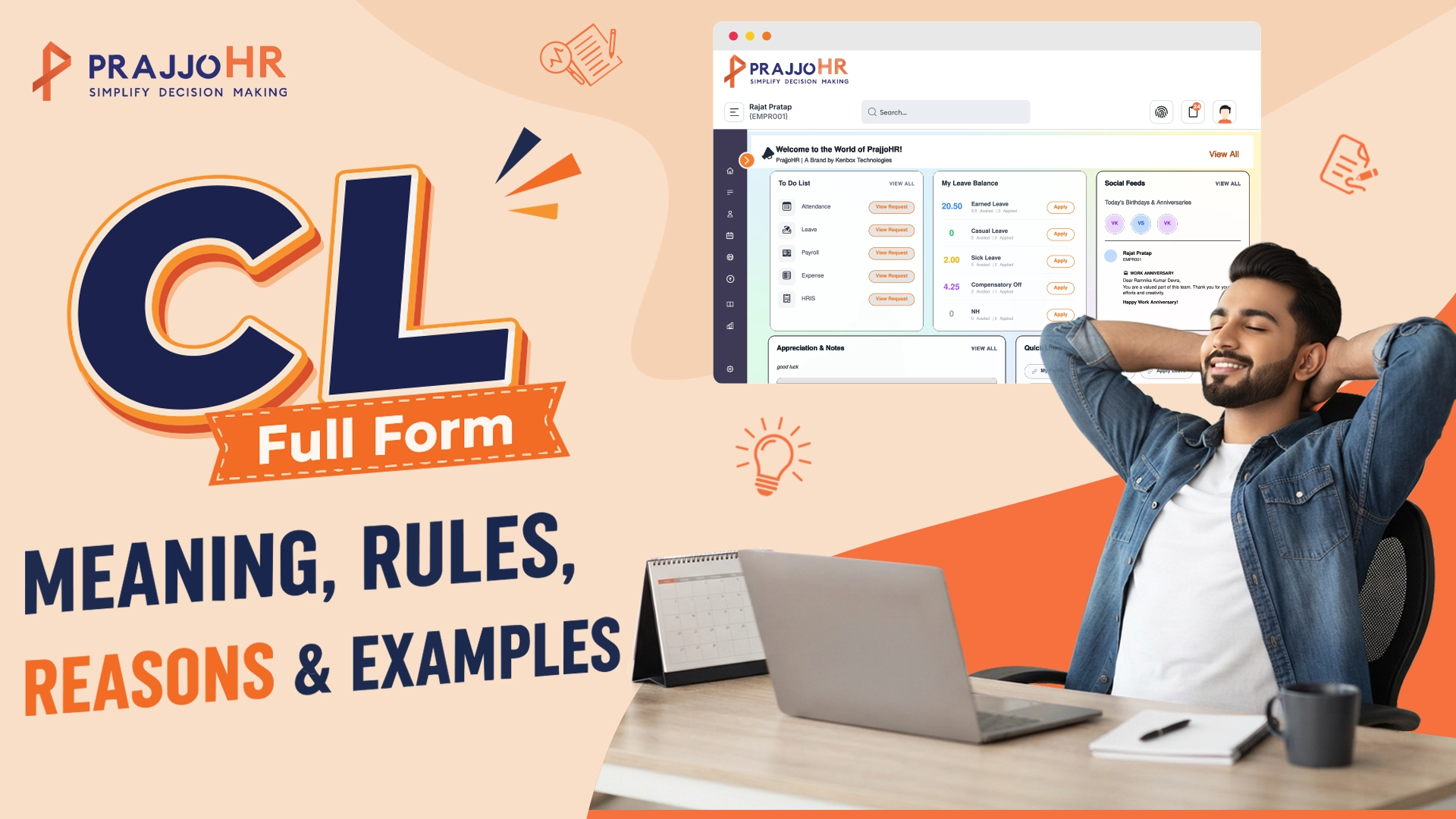
Casual leave is a common term used in offices and workplaces when employees need time off for short-term personal work. But many employees still search for the CL full form to understand what CL actually means, how it works, and when they can use it.
In the corporate world, casual leave is an important part of employee leave and attendance management. Understanding its rules helps employees and HR teams manage leave more effectively.
CL Full Form: What Does CL Stand For?
The CL full form is Casual Leave. It refers to a type of leave that employees can generally use for short-term personal work, unexpected situations, appointments, or other occasional needs. The exact number of CL days and rules can differ according to the company's leave policy and applicable employment laws.
What Does CL Mean in the Corporate World?
In the corporate world, CL or Casual Leave gives employees flexibility when they need a short break from work for personal reasons. It is generally intended for situations that do not require a long period of absence.
For example, an employee may need to visit a bank, attend a family function, go to an appointment, or manage an urgent personal task during working hours. Instead of being absent without informing the organization, the employee can apply for casual leave according to company policy.
From an HR management perspective, casual leave is also connected with attendance and employee records. When leave applications are properly recorded, HR teams can maintain accurate attendance information and ensure that payroll calculations are based on correct employee data.
Why Does Casual Leave Matter in Corporate Life?
Casual leave matters because employees may need time away from work for personal responsibilities that cannot always be planned in advance. A well-managed leave policy can support both employee needs and business operations.
1. Helps Employees Manage Personal Responsibilities
Employees have responsibilities outside the workplace, and some tasks need attention during working hours.
Casual leave allows employees to handle short personal requirements without being unnecessarily marked absent.
2. Supports Work-Life Balance
Employees may occasionally need time to manage family commitments, appointments, or other personal matters.
Providing reasonable leave options can help employees maintain a healthier balance between their professional and personal responsibilities.
3. Improves Attendance Management
A clear casual leave process gives employees a formal way to communicate when they cannot attend work.
For HR teams, properly recorded CL applications make attendance management easier and reduce confusion about whether an employee was absent, on leave, or working.
4. Supports Employee Engagement
Employees are more likely to feel supported when an organization has a clear and practical leave policy.
Giving employees reasonable flexibility can contribute to a positive workplace experience and support employee engagement .
Casual Leave Rules in India: A Complete Guide
While policies differ from company to company, most CL rules follow a similar pattern:
Limited number of days - CL is usually provided with a fixed annual limit, such as a specific number of days per year or a monthly quota.
Cannot be carried forward - In many organizations, unused casual leave cannot be carried forward to the next leave year and may lapse at the end of the year.
Cannot be combined with other leaves - Many companies don't allow CL to be clubbed with Sick Leave or Earned Leave for extended breaks.
Advance or same-day intimation - Employees are generally expected to apply for CL in advance when possible. Same-day leave may also be permitted for genuine or unexpected situations.
Restricted during notice period or probation - Some organizations may have specific restrictions on casual leave during the probation period or notice period, depending on their internal HR policy.
No documentation required - Casual leave generally does not require documents such as a medical certificate because it is normally intended for personal or short-term requirements.
When Can Employees Take Casual Leave? Common Reasons With Examples
Employees may use casual leave for different short-term personal requirements. The exact reasons accepted can depend on the organization's leave policy.
Here are some common situations where employees may request casual leave:
1. Personal Appointments
Employees may need time away from work to attend appointments that cannot be scheduled outside office hours.
Common examples:
Doctor or dentist appointment
Bank appointment
Meeting with a financial advisor
Government office visit
Important personal appointment
Real-life example: An employee needs to visit the bank to complete an important document verification process during working hours. The employee can apply for one day of CL according to company policy.
2. Family Responsibilities
Family responsibilities can sometimes require an employee's presence during working hours.
Common examples:
Attending a family function
Taking a family member to an appointment
Handling an urgent family matter
Attending a parent-teacher meeting
Supporting a family member during an important event
Real-life example: An employee needs to attend a parent-teacher meeting at their child's school in the morning. They may request casual leave if the timing overlaps with their working hours.
3. Unexpected Personal Work
Not every personal task can be planned in advance, and employees may occasionally need short-notice leave.
Common examples:
Urgent household work
Vehicle-related work
Unexpected documentation work
Important personal errands
Emergency situations at home
Real-life example: An employee's vehicle suddenly develops a serious problem before work, and they need to take it to a service center. Depending on company policy, they may request CL for the day.
4. Religious, Cultural or Social Events
Employees may sometimes need time away from work to participate in important personal, religious, cultural, or social occasions.
Common examples:
Family celebrations
Religious events
Cultural programs
Important community events
Personal ceremonies
Real-life example: An employee needs to attend an important family ceremony that takes place during office hours. They can apply for casual leave in advance if permitted by their organization's leave policy.
5. Short Personal Breaks or Travel
Employees may sometimes need a short break for personal travel or an important commitment.
Common examples:
Short personal trips
Attending an important event in another city
Personal commitments
Moving-related work
Completing important errands
Real-life example: An employee needs to travel to another city for an important personal matter and requires one working day away from the office. They can request CL through the company's leave process.
Casual Leave vs Earned Leave: Key Difference
Understanding the difference between casual leave and earned leave helps employees choose the appropriate leave type for different situations.
| Aspect | Casual Leave (CL) | Earned Leave (EL) |
|---|---|---|
| Full Form | Casual Leave | Earned Leave |
| Main Purpose | Short-term or occasional personal needs | Planned or longer periods of leave |
| Typical Use | Personal work, appointments, urgent requirements | Vacations, extended personal plans, longer breaks |
| Planning | Can be planned or required at short notice | Usually planned in advance |
| Flexibility | High (last-minute options) | Lower (planned requirement) |
| Carry Forward | Cannot carry to next year | Can accumulate |
| Encashment | Generally not intended for encashment, subject to applicable rules | May be eligible for encashment in certain circumstances |
| Documentation | Usually not required | May be required |
The exact treatment of CL and EL should always be checked against the applicable employment regulations and the organization's leave policy.
How to Apply for Casual Leave: A Step-by-Step Guide
The process for applying for CL may differ between organizations, but most companies follow a simple leave application and approval process.
Step 1: Check Your Leave Balance
Before applying, check whether you have sufficient casual leave available.
An HRMS software or employee self-service portal can make it easier to view your current leave balance.
Step 2: Select the Leave Dates
Choose the date or dates on which you need casual leave.
Make sure the selected dates follow your organization's leave rules and consider important work commitments.
Step 3: Submit the Leave Application
Submit your CL request through the company's prescribed process, such as an HR portal, mobile application, email, or leave management system.
Mention the required dates and any information requested by your organization.
Step 4: Wait for Manager Approval
The leave request may be sent to your reporting manager or the designated approver.
The manager can review the request and approve or reject it based on business requirements and company policy.
Step 5: Check Your Attendance Record
After approval, make sure the leave is correctly reflected in your attendance record.
In an integrated HR system, approved leave can automatically update attendance information and help HR maintain accurate records for payroll processing.
Conclusion
The CL full form is Casual Leave, and it is commonly used when employees need short-term time away from work for personal or occasional requirements. It provides flexibility to employees while giving organizations a structured way to manage employee absence.
For HR teams, effective casual leave management is not only about approving leave requests. It is also connected with attendance management, payroll management, employee records, HR management, and employee engagement.
As organizations grow, managing leave through spreadsheets and manual processes can become difficult. An integrated HRMS software can help businesses manage leave, attendance, payroll, and other HR processes from a centralized platform.
With PrajjoHR businesses can simplify their HR operations through connected HR and payroll solutions, making everyday HR management more efficient and organized.
Experience Next-Generation
HR Software in Action
People-Centric HRMS: AI That Aligns Mission, People & Performance